Focus USA: Low carbon could be a reality
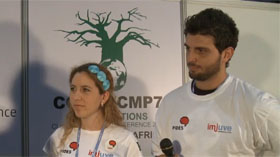
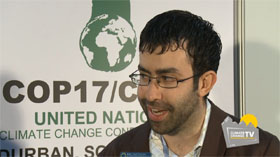
Is the US getting a tough deal out here? Miguel Sossa from the University of Michigan came into the Climate Change Studio to argue that while the USA’s negotiating position might not impress many delegates, there is plenty within the country to be optimistic about.
Transcript :::::::::::::::::::::::::::::::::::::::::::::::::::::::::::::::::::::::::::::::::
RTCC: I’m joined on the podium by Miguel Sossa from the University of Michigan
Miguel Sossa, University of Michigan: Pleasure to be here.
RTCC: Miguel, we didn’t think that anybody from the USA cared about climate change? And here you are.
Miguel Sossa, University of Michigan: Well we’ve come a long way. It took 30 hours to get from Michigan and I would say the United States cares quite a bit about climate change. The government currently under the Obama administration has been trying to push forward an agenda that makes sense for the US and for the world. The biggest challenge for us is the political divide between those that believe that climate change actually has an adequate place in the marketplace and those that feel that environmental pursuits are actually the cause of slowing down the economy. I believe that we are here as students of the University of Michigan and the Erb Institute to learn as much as we can so that we can come back to our university and educate our students on both the pros and cons of climate change policy. Our hope is that we can push forward an agenda that makes sense later on. We believe that we are going to be the future leaders and how else to learn but to come and see it from those that are doing it.
RTCC: And joking aside, there is plenty in the US to be optimistic about. If you look at REGI initiative and California has obviously launched a number of stringent emissions caps. There is a lot going on perhaps below state level?
Miguel Sossa, University of Michigan: I think on a local level, what you’re finding and we’re looking even in cities in the northwest of the United States like Seattle and Portland who have really pushed forward a green agenda on their city development. There are a lot of people here in Durban that are anxious to see what the US’s negotiation process will be and negotiation stance. But to your point, there is a lot going on at a city level, state level and certainly there are federal level agendas that are happening with EPA to push forward an agenda that makes sense.
RTCC: And I noticed that President Obama recently, I think he recently passed an emissions cap on vehicles or at least they are trying to. University of Michigan, obviously Detroit is the capital of Michigan and Detroit is also the home of motor cars in the USA, what’s happening on that scale in the US? Are the General Motors and Fords implementing green strategies?
Miguel Sossa, University of Michigan: Absolutely. And I think you find it in a couple of different ways so Ford and GM are both creating electric vehicles. They have also led the way in terms of emissions reductions in the US for both automotive and some of their pursuits and their fundraising and volunteering aspects and you’ll see that the emissions that are happening in the car industry are actually decreasing quite a bit so it’ll be an interesting space to see what Detroit plays in that role.
RTCC: Absolutely. And part of the reason you’re here for the next two weeks is the carbon markets, how optimistic are you about carbon markets? Because obviously recently we’ve seen a carbon price crash and there is a lot of unsettlement due to the Kyoto protocol, will or won’t that continue? How much money would you put on the carbon markets continuing?
Miguel Sossa, University of Michigan: Well I think we’ve seen, to your point, we’ve seen the carbon market can of stymieing and slow down and what we are here to present this week is sort of an angle on how do you professionalise the carbon markets? We were joking I think earlier that the carbon markets are a bit boring for most people. But if you look at the climate change initiatives that are happening as a result of global warming, carbon is at the epicenter. And when you’re trying to find ways to speak to both the economic leaders of the world and the business folks that are investing their money, you need to put it in a dollar amount, and what better way to do that than to take a look at a market can equitably distribute that burden, as well as place a means for people to actually invest and to grow. So if I was a betting man, I’d say go ahead and put your money in carbon – I think it’s going to be the way to sort of pursue that angle.
Category: Climate Change TV, Durban Latest, UNFCCC Videos