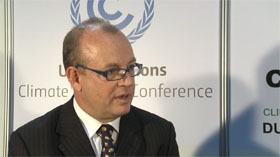
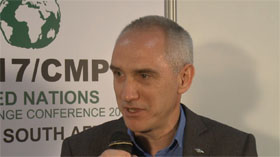
Mr Luc Gnacadja, Executive Secretary at the UNCCD

December 2011


Mr Luc Gnacadja, Executive Secretary at the UNCCD came into the Climate Change Studio on Gender Day to talk about the disproportionate effect of desertification on women.
Transcript :::::::::::::::::::::::::::::::::::::::::::::::::::::::::::::::::::::::::::::::::

RTCC: Women are disproportionally affected by desertification, how is that? Can you explain in some more detail why that is they case.

Luc Gnacadja: Because they have less access to productive land, less access to secure land and to resources for investment. In that regard, we noticed that if only we could ensure gender equity in the rural areas in agriculture, we may certainly in developing countries increase yield by up to 4%. In the lands that are managed by woman, we may end up reducing poverty by up to 12%. Globally speaking, that’s quite important and huge.

RTCC: Is there general acceptance and recognition of the fact in the governments affected by desertification that gender is an issue? Is that a challenge you face, trying to convince governments that they should be tackling the issue?

LG: Oh yes, we still have a long way to go. That’s why in the text of the convention, actually out of the three Rio conventions, this is the one where you can see a specific mention of gender as the avenue to address degradation and desertification. We still have a long way to go to mainstream gender in action in addressing desertification, land degradation and drought. When you consider for instance counties where drought is prevailing, we notice that women and children are the last to leave the land. They are the most affected by drought and desertification. When drought implies famine, they are also the most heavily affected.

RTCC: Of course, every year we are seeing more deserts. Desertification is expanding unfortunately. So I assume that more women involved in the debate. Is that the case?

LG: Just look at what is happening and still on-going in the Horn of Africa. Look at the people who are on the refugee camps. You will see most of them are women and children. If you look at the number of casualties, we also agree that we really have to make sure that we mainstream gender including in drought preparedness and drought risk management. We need to ensure that they are included not just after the decisions are taken, but rather right from the start when discussions are on-going to prepare and design action.

RTCC: You’re making advances on this issue in Rio+20, tell me what’s going to happen there next year?

LG: Well in Rio+20, precisely because we know that women are agents of change and that if we take action by more inclusive processes, then we will reduce the degradation but we also will address more effectively poverty alleviation. We believe that in Rio+20, the world needs to deliver something that will better add to our synergies. Out of Rio, now nine years ago, we have agreed that sustainable development is about three pillars, and that the environmental pillars is also about three other pillars: biodiversity, climate change and land degradation and desertification. Unfortunately out of Rio, we have built around those pillars ivory towers. Now we really need processes that will drive synergies. It’s not just first and foremost about institutional approaches, it’s rather about a paradigm shift. That’s why we are calling for what some agree to call the sustainable development goal. That will be inclusive, that will provide incentive for synergies. Synergies will not happen by accident, it will happen because we have deliberately taken action for that. We’re promoting what we call the need to build a land degradation neutral world. The land degradation neutral world will be about agreeing to move towards a zero net land degradation rate, globally speaking. This can be implemented at all level of action, from local to global. What does it mean? That number one: we must prevent degradation. Number two: we must offset any unavoidable degradation by land being restored. Just keep in mind that out there we have two billion hectares of degraded forest and agricultural land that has been degraded. That’s the whole potential for restoration. It’s an incredible amount for action and investment. It’s about water. You know when we talk about water scarcity, let us bear in mind that the resources of water that we have as humanity is the same that nature has been recycling since water appeared on Planet Earth! So scarcity most of the time comes from mismanagement of land and soil. The way we have to increase what we call green water is by managing soil to increase infiltration, to refill the aquifer and to reduce the run-off. So all this, if you want it to happen, it will therefore contribute to climate change adaptation, climate change mitigation, resilience building. In fact to build resilience, especially in the agricultural world, what we have is soil, soil potential for addressing resilience and building capacity for adaptation. That is why we are calling in Rio for a real paradigm shift towards synergies and of course women will be centre stage in synergies.

Tags: , ,

Category: Climate Change TV, Durban Latest, UNFCCC Videos