UNFCCC chief Figueres on women and climate change

December 2011


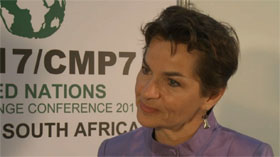
Christiana Figueres came to the Climate Change TV studio for Gender Day to talk about how women can be agents of change when it comes to adaptation.
Transcript :::::::::::::::::::::::::::::::::::::::::::::::::::::::::::::::::::::::::::::::::

RTCC: I’d like to welcome Christiana Figueres, the Executive Secretary of the UNFCCC. Thank you very much for joining us. To start off, it might be useful to an audience that isn’t closely following the climate change debate as to why gender is a climate change issue. Why is it so important?

Christiana Figueres, UNFCCC: It’s very clear what the intricate link is. That is because women are disproportionately affected by climate change, women are the most vulnerable to the adverse affects of climate change and also because women are actually perhaps our strongest key agent of adaptation. On both sides, because of the vulnerability and because of the potential that women have to contribute to the solution they are really one of the most important components here.

RTCC: There were 6 agreements at Cancun on gender issues, there is going to be a focus on gender at Rio +20. Is the debate on gender as far advanced as you would like it to be at this stage?

Christiana Figueres, UNFCCC: Definitely not, we are behind schedule but we have come a long way. We were a convention born without any mention of gender whatsoever. That was 20 years ago and we have been able to progress in to now having out of Cancun very specific mentions in the Cancun agreement as to where gender is important in particular in adaptation and in mitigation. That is at least, opening up the door a little bit but that, of course, is not enough because it’s not about inserting the word ‘gender’ in to a negotiating text or even in to an agreement. It’s about actually using these instruments to finally get down to the women who are on the ground, in the field and getting for them to be able to benefit from this. That is the real challenge. It’s not about yes we’re proud that we have six mentions; yes we’re proud that in the secretariat we had a fellow from Mongolia and a fellow from Nigeria who were working with us on gender issues but that’s not the end result. That is only the way that we use to really get to the end result. Let me give you two astonishing facts, which really very crisply put out there what the challenge is. 80% of the food production in Africa is produced by women. In the world, 50% of us women still cook on open stoves. You can imagine what that means. It means that we women are responsible for water, mostly around the world – we are the ones who go and get the water that we need for our families. We are mostly responsible for food production and we are mostly responsible for food cooking. All of those activities, of course, are affected by climate and affect climate because in as much women continue to use open fires, they are contributing to deforestation, they are contributing to really bad health situations, broncal situations in their families. So there is a lot of opportunity to help women improve the quality of their lives while they can contribute to the solution.

RTCC: Is there still a difficulty that while we may achieve gender equity at meetings like COP 17 and beyond – if you walk in to any financial district pretty much around the world and you’ll see predominately men there, if you walk in to any board room of carbon emitting companies and there will be mostly men. Is that an obstacle do you think, to the advancement of the gender issue within the climate change framework?

Christiana Figueres, UNFCCC: It could be but I don’t think that that is the main obstacle. The main obstacle is our mental shift that we have to realise that women are not just disproportionately affected but that women can be such a solution. We are 50% of the population around the world and we represent more than 50% of the solution.

RTTC: Women are obviously mothers as well.

Christiana Figueres, UNFCCC: Yes.

RTCC: So the issue of children is becoming increasingly prominent in these negotiations, where are we in relation to the debate on how climate change affects children?

Christiana Figueres, UNFCCC: They too because they are the vulnerable generation, they are definitely affected in a negative way but I have such hope for that new generation we women, wise that we are, are investing and imbuing in the next generation the awareness of climate. I’m really very confident that children are going to grow up with vary different behaviors from what we have. My own daughters are my best ‘police women’ with respect to the behaviors in our family and I have seen so many young people here at the COP, outside of the COP, in schools in South Africa, so many of them saying: ‘we understand that we cannot continue doing what the previous generation has done.’ We cannot allow that anymore. That business as usual that we had is something completely irresponsible and just no longer sustainable and the next generation is changing that. Thank heavens!

Tags: , , ,

Category: Climate Change TV, Durban Latest, UNFCCC Videos