


Page 11 - respond-cop31
P. 11
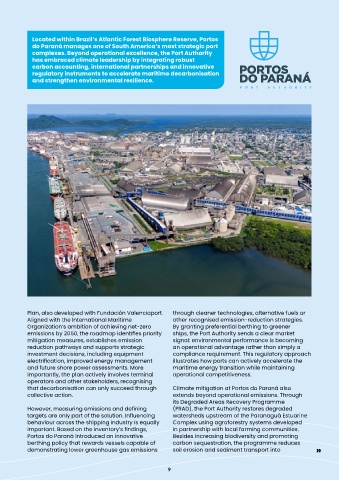
Located within Brazil’s Atlantic Forest Biosphere Reserve, Portos
            do Paraná manages one of South America’s most strategic port
            complexes. Beyond operational excellence, the Port Authority
            has embraced climate leadership by integrating robust
            carbon accounting, international partnerships and innovative
            regulatory instruments to accelerate maritime decarbonisation
            and strengthen environmental resilience.


           Plan, also developed with Fundación Valenciaport.   through cleaner technologies, alternative fuels or
           Aligned with the International Maritime            other recognised emission-reduction strategies.
           Organization’s ambition of achieving net-zero      By granting preferential berthing to greener
           emissions by 2050, the roadmap identifies priority   ships, the Port Authority sends a clear market
           mitigation measures, establishes emission          signal: environmental performance is becoming
           reduction pathways and supports strategic          an operational advantage rather than simply a
           investment decisions, including equipment          compliance requirement. This regulatory approach
           electrification, improved energy management        illustrates how ports can actively accelerate the
           and future shore power assessments. More           maritime energy transition while maintaining
           importantly, the plan actively involves terminal   operational competitiveness.
           operators and other stakeholders, recognising
           that decarbonisation can only succeed through      Climate mitigation at Portos do Paraná also
           collective action.                                 extends beyond operational emissions. Through
                                                              its Degraded Areas Recovery Programme
           However, measuring emissions and defining          (PRAD), the Port Authority restores degraded
           targets are only part of the solution. Influencing   watersheds upstream of the Paranaguá Estuarine
           behaviour across the shipping industry is equally   Complex using agroforestry systems developed
           important. Based on the inventory’s findings,      in partnership with local farming communities.
           Portos do Paraná introduced an innovative          Besides increasing biodiversity and promoting
           berthing policy that rewards vessels capable of    carbon sequestration, the programme reduces
           demonstrating lower greenhouse gas emissions       soil erosion and sediment transport into          »


                                                            9

