


Page 16 - respond-cop31
P. 16
HOW SMARTER LIGHTING

           CAN HELP CITIES EVOLVE


           From harbour walks to neighbourhood streets,
           light shapes how a city is experienced after dark.
           It influences how people move. How safe they
           feel. And how public spaces come to life. But
           lighting also shapes something less visible: the
           way cities use energy, manage resources and
           invest for the future.

           Cities are already recognizing that potential.
           A 2025 assessment found that nearly 90% of
           participating cities include lighting measures
           in their climate action plans. In half of those
           cities, lighting accounts for more than 5% of total
           electricity consumption.

           Lighting has already shown what large-
           scale transformation can achieve. In 2006, it
           accounted for around one fifth of global electricity
           consumption. Thanks to advances in LED
           technology, that share has dropped to 9%, even
           as demand for lighting has continued to grow.
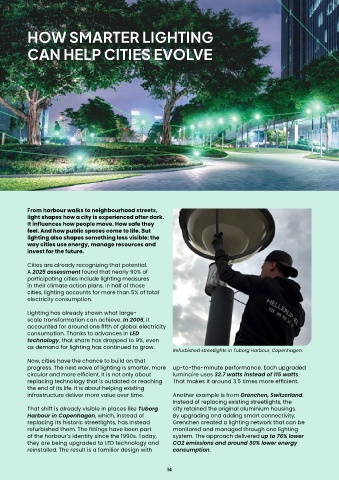
                                                              Refurbished streetlights in Tuborg Harbour, Copenhagen.
           Now, cities have the chance to build on that
           progress. The next wave of lighting is smarter, more   up-to-the-minute performance. Each upgraded
           circular and more efficient. It is not only about   luminaire uses 32.7 watts instead of 115 watts.
           replacing technology that is outdated or reaching   That makes it around 3.5 times more efficient.
           the end of its life. It is about helping existing
           infrastructure deliver more value over time.       Another example is from Grenchen, Switzerland.
                                                              Instead of replacing existing streetlights, the
           That shift is already visible in places like Tuborg   city retained the original aluminium housings.
           Harbour in Copenhagen, which, instead of           By upgrading and adding smart connectivity,
           replacing its historic streetlights, has instead   Grenchen created a lighting network that can be
           refurbished them. The fittings have been part      monitored and managed through one lighting
           of the harbour’s identity since the 1990s. Today,   system. The approach delivered up to 76% lower
           they are being upgraded to LED technology and      CO2 emissions and around 30% lower energy
           reinstalled. The result is a familiar design with   consumption.


                                                            14

