


Page 18 - respond-cop31
P. 18
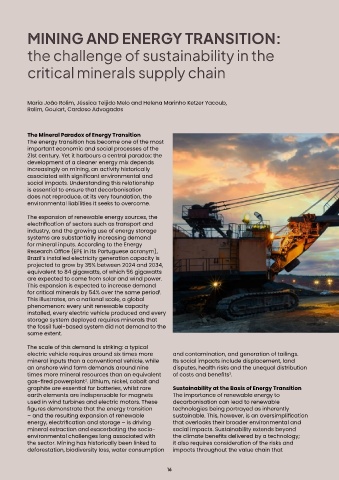
MINING AND ENERGY TRANSITION:


           the challenge of sustainability in the

           critical minerals supply chain


           Maria João Rolim, Jéssica Teijido Melo and Helena Marinho Ketzer Yacoub,
           Rolim, Goulart, Cardoso Advogados


           The Mineral Paradox of Energy Transition
           The energy transition has become one of the most
           important economic and social processes of the
           21st century. Yet it harbours a central paradox: the
           development of a cleaner energy mix depends
           increasingly on mining, an activity historically
           associated with significant environmental and
           social impacts. Understanding this relationship
           is essential to ensure that decarbonisation
           does not reproduce, at its very foundation, the
           environmental liabilities it seeks to overcome.

           The expansion of renewable energy sources, the
           electrification of sectors such as transport and
           industry, and the growing use of energy storage
           systems are substantially increasing demand
           for mineral inputs. According to the Energy
           Research Office (EPE in its Portuguese acronym),
           Brazil’s installed electricity generation capacity is
           projected to grow by 35% between 2024 and 2034,
           equivalent to 84 gigawatts, of which 56 gigawatts
           are expected to come from solar and wind power.
           This expansion is expected to increase demand
           for critical minerals by 54% over the same period . 1
           This illustrates, on a national scale, a global
           phenomenon: every unit renewable capacity
           installed, every electric vehicle produced and every
           storage system deployed requires minerals that
           the fossil fuel-based system did not demand to the
           same extent.

           The scale of this demand is striking: a typical
           electric vehicle requires around six times more    and contamination, and generation of tailings.
           mineral inputs than a conventional vehicle, while   Its social impacts include displacement, land
           an onshore wind farm demands around nine           disputes, health risks and the unequal distribution
                                                                                  3
           times more mineral resources than an equivalent    of costs and benefits .
                               2
           gas-fired powerplant . Lithium, nickel, cobalt and
           graphite are essential for batteries, whilst rare   Sustainability at the Basis of Energy Transition
           earth elements are indispensable for magnets       The importance of renewable energy to
           used in wind turbines and electric motors. These   decarbonisation can lead to renewable
           figures demonstrate that the energy transition     technologies being portrayed as inherently
           – and the resulting expansion of renewable         sustainable. This, however, is an oversimplification
           energy, electrification and storage – is driving   that overlooks their broader environmental and
           mineral extraction and exacerbating the socio-     social impacts. Sustainability extends beyond
           environmental challenges long associated with      the climate benefits delivered by a technology;
           the sector. Mining has historically been linked to   it also requires consideration of the risks and
           deforestation, biodiversity loss, water consumption   impacts throughout the value chain that


                                                            16

